
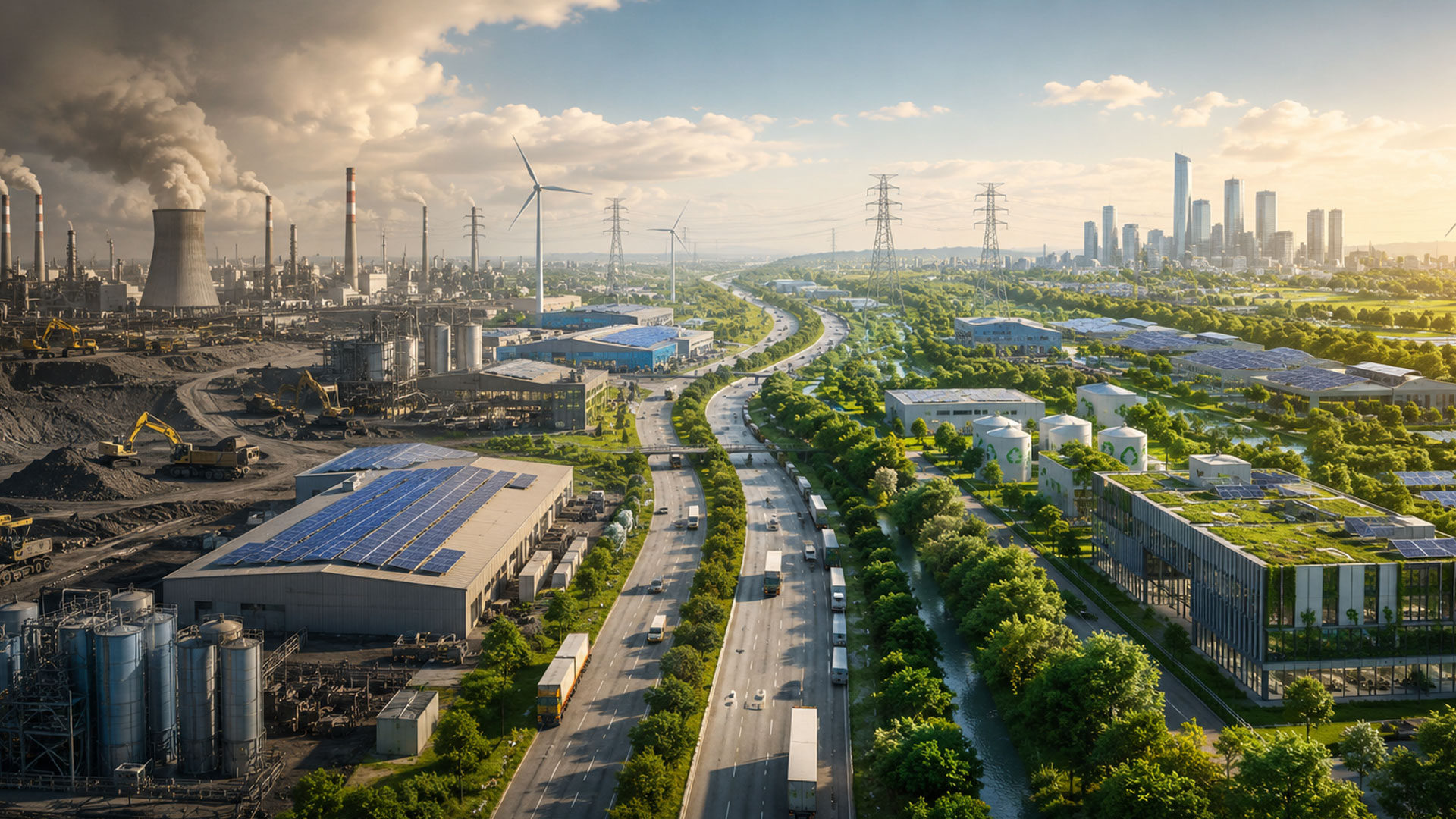
From Green Growth To Sustainable Productivity
For much of the modern economic era, growth has been built on a simple formula: more production, more consumption, more labor and, more capital. This model has delivered extraordinary improvements in living standards, but it has also relied heavily on abundant energy, natural resources, and increasingly intensive use of the planet’s productive capacity. That model is becoming harder to sustain. Climate crisis is raising the economic costs of inaction. Energy security has become a strategic priority. Demographic ageing is constraining labor supply, while productivity growth has weakened across many economies. At the same time, resource constraints and geopolitical tensions are exposing the vulnerabilities of highly resource-intensive and globally interconnected production systems.
The challenge, therefore, is not simply to make economic growth “greener.” It is to build a new model of growth that is more productive, more resilient, and less dependent on the continual expansion of physical inputs. This requires a shift in perspective. Sustainability should not be viewed only as an environmental constraint on economic activity. It is increasingly a productivity challenge: how can economies generate more value from every unit of energy, capital, labor, and natural resources they use?
The connection is already visible in energy. If a factory produces the same output using less electricity, it has not only reduced its environmental footprint, it has become more productive. The same applies to a logistics company that reduces empty journeys, a manufacturer that uses fewer raw materials, or a city that reduces congestion through better infrastructure and digital systems. Sustainability, in this sense, is fundamentally about doing more with less. This creates several new sources of productivity growth. Clean energy, for example, is no longer simply a tool for reducing emissions. Investment in renewable generation, electricity networks, storage, nuclear power and electrification is creating new infrastructure and reshaping the cost and security of energy. The International Energy Agency estimates that global energy investment reached around $3.3 trillion in 2025, with approximately $2.2 trillion directed toward clean energy technologies and systems[1].
Resource efficiency offers another opportunity. A large amount of material that is extracted, transported, processed and, ultimately discarded represents not only environmental waste but also economic inefficiency. Circular production, recycling, product redesign and better resource management can reduce costs while increasing the value generated from each unit of input. Digitalization can accelerate these gains. Sensors, artificial intelligence, advanced analytics and automation can optimize energy use, logistics, inventory and industrial processes. The next productivity revolution may not come from one transformative invention, but from embedding digital intelligence into millions of existing economic activities.
The critical question is whether the green transition should be understood primarily as a cost to growth or as the foundation of the next growth cycle. There are genuine short-term costs. Companies must replace infrastructure, invest in new technologies and adapt production processes. Workers may need new skills, consumers may face higher upfront costs, and governments must finance substantial infrastructure investment. Some existing assets will lose value before the end of their expected lives.
But these costs should not automatically be interpreted as a reduction in long-term economic welfare. Much of the transition is investment: in infrastructure, technology, human capital and future productive capacity. The economic question is whether these investments generate returns that outweigh their costs. This is where the distinction between transition costs and investment costs becomes important. A new electricity grid may be expensive today but increase economic resilience for decades. Energy-efficiency investments may require upfront capital but reduce operating costs over time. Research and development may not immediately affect GDP but can generate entirely new industries and technologies. The transition will therefore be economically successful not when it eliminates costs, but when it converts today’s costs into tomorrow’s productivity gains. This also requires businesses and governments to rethink how they measure sustainability. Reporting significant amounts of carbon emissions or the amount spent on green initiatives is no longer enough. A more useful concept is productive sustainability which measure whether sustainability investments improve the underlying economics of production.
For businesses, this could mean tracking energy productivity, resource productivity, carbon productivity, innovation returns, and resilience to energy-price or supply-chain shocks. For governments, it means looking beyond emissions reductions to measure changes in productivity, investment, employment, innovation, household costs and economic resilience. This perspective also changes the role of public policy. Governments do not need to determine which technologies will ultimately succeed; rather, they need to create the conditions that enable investment and innovation to flourish: predictable regulation, efficient permitting processes, reliable infrastructure, a skilled workforce, competitive markets, and effective incentives. Public capital should increasingly be used to mobilize private investment rather than permanently substitute for it. Companies face a similar imperative. Those that reduce their energy and resource intensity can lower costs and improve efficiency. Those that invest early in emerging technologies can gain competitive advantages, while those that build resilience into their supply chains can reduce their exposure to future shocks.
Certainly, the transition will not be smooth. There will be technological failures, stranded assets, political resistance, and periods in which short-term costs outweigh visible benefits. Yet economic transformations rarely occur because the old model suddenly disappears. They occur because new sources of productivity gradually become more attractive and economically viable.
The opportunity, therefore, is not to choose between economic growth and sustainability, but to redefine what drives growth. The central question today is not whether sustainability will constrain growth, but whether sustainability itself can be recognized as a driver of productivity and, ultimately, as a foundation for the next era of economic growth.
[1] https://www.wri.org/insights/state-clean-energy-charted