
Bioeconomy In Action: Turning Territorial Potential Into Sustainable Business Opportunities
The future of sustainable economic growth will depend not only on producing more but also on creating measurable value while restoring natural systems and strengthening communities. This is particularly relevant for businesses, governments, and investors seeking financially sound, socially inclusive, and environmentally responsible decisions. The bioeconomy can contribute to this goal, but only when territorial potential is translated into viable strategies rather than celebrated as an abstract promise.
Biodiversity alone does not create economic opportunities. Many biodiversity-rich territories export low-value raw materials, lose agricultural by-products, face limited market access, and see local knowledge disconnected from innovation systems. Therefore, the strategic question is not simply, what biological resources exist? It is, under what conditions can they generate lasting value within the territory?
Answering this requires a territorial opportunity assessment that connects five dimensions: biological resources and ecosystem limits, local knowledge and productive capabilities, market demand, financial feasibility, and the distribution of risks and benefits. This broader lens helps distinguish a genuinely sustainable opportunity from a conventional business idea with a green label.
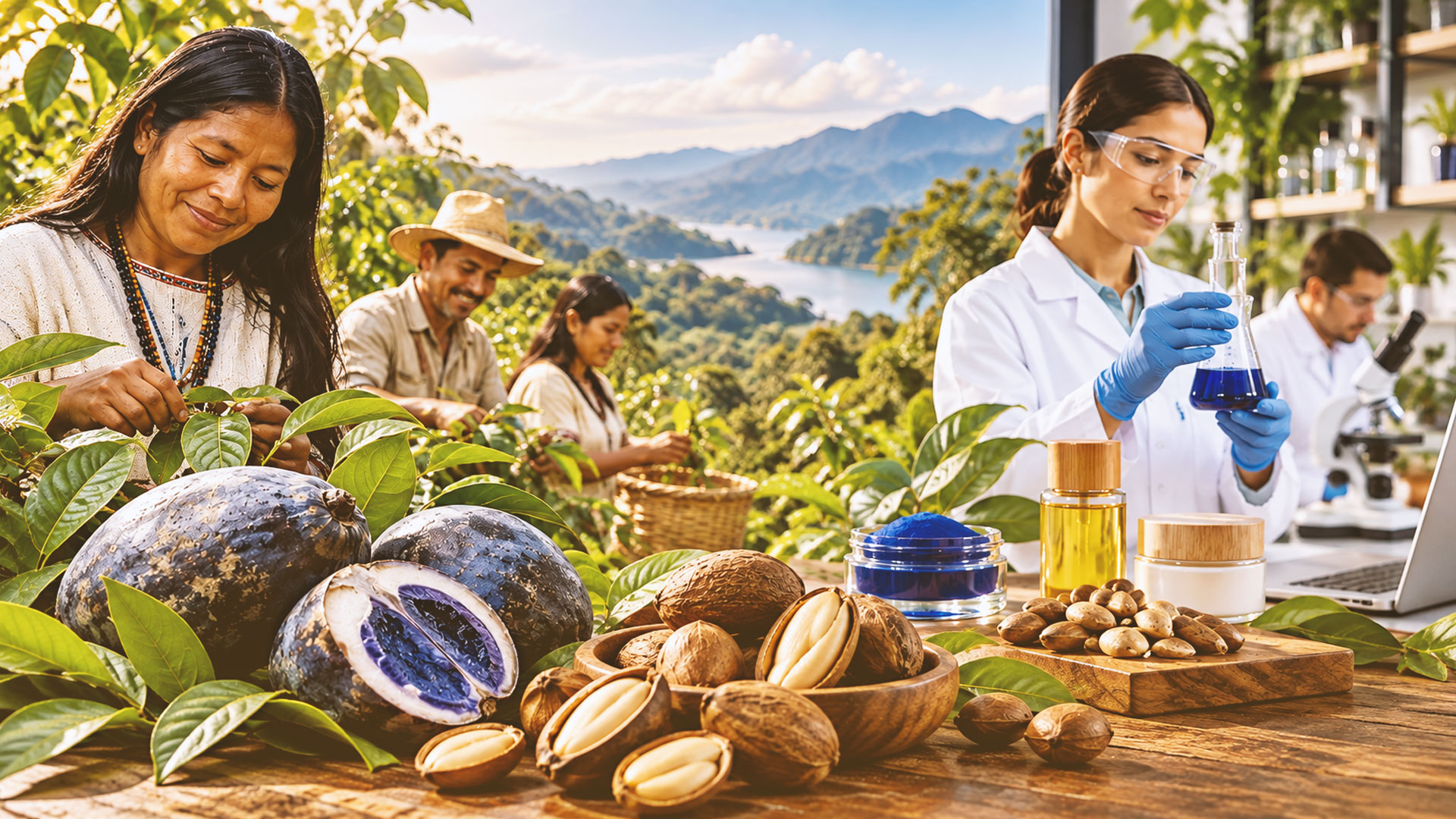
A Colombian case shows how these elements can converge. Ecoflora Cares developed and patented a natural blue colorant from jagua (Genipa americana), a fruit long used by Indigenous communities [2, 3]. The company connected scientific research with a clear market need for natural colorants, obtained U.S. Food and Drug Administration (FDA) approval for food applications in 2023 [1], and developed supply relationships with small farmers and Indigenous communities [2]. Jagua is grown through agroforestry and silvopastoral systems [6], and Ecoflora has entered into benefit-sharing agreements with several Embera community groups [3]. The result is not simply a new product; it is a value chain that links biodiversity, innovation, rural income, market access, and ecosystem restoration. Its experience also shows that reaching the market requires years of research, regulatory work, partnerships, and patient investment [5].
A complementary Colombian pathway is Kahai, which industrializes cacay, an Amazonian nut, to produce high-value cosmetic oils and proteins. According to Colombia’s Ministry of Science, its model includes cultivation and wild harvesting, reforestation, and income generation for more than 200 rural and Indigenous families [4]. Together, Ecoflora and Kahai experiences show how territories can move beyond exporting raw biodiversity by connecting local supply, processing, technology, differentiated markets, and restoration.
The same rigor should be applied to the impact. Revenue and profitability matter, but they do not reveal who captures value, which capacities remain in the territory, or whether the ecosystems are being protected. Therefore, bioeconomy initiatives should measure economic, social, environmental, and territorial outcomes. Useful indicators include local income, jobs created, producer participation, resources regenerated, emissions avoided, and the share of value retained locally.
Collaboration is equally important in this regard. Businesses cannot independently build territorial bioeconomies. Communities, producers, governments, universities, research centers, and financial institutions hold different knowledge, resources, and decision-making power. Their coordination can reduce uncertainty, protect local knowledge, strengthen trust, and create fairer mechanisms for sharing values.
Therefore, the bioeconomy in action is not a portfolio of green products. It is a disciplined process of identifying, testing, financing, and measuring opportunities that connect competitiveness and regeneration. When economic evidence is combined with territorial knowledge and shared decision-making, organizations can move beyond sustainability commitments toward business models that are viable, resilient, and capable of strengthening the systems on which long-term prosperity depends.
Johana Regino Vergara
[1] U.S. Food and Drug Administration (FDA). Listing of Color Additives Exempt From Certification; Jagua (Genipin-Glycine) Blue. Federal Register, November 3, 2023.
[2] Oterra. Oterra and Ecoflora Cares join forces to build a world of responsibly sourced naturally colored foods in Blues and beyond. Press release, December 5, 2023.
[3] Universidad de Antioquia. Jagua blue, the natural colorant discovered at the UdeA. English version. Spanish original: Azul de jagua, el tinte ancestral que con investigación UdeA se podrá usar en la industria como colorante. February 20, 2024.
[4] Ministerio de Ciencia, Tecnología e Innovación (MinCiencias), Portafolio BIO. Aceite de cacay [Cacay oil] and Proteína de cacay [Cacay protein]. [Español; English translation of titles added]
[5] Swisscontact. Tejiendo redes a través del Azul de Jagua: La Transformación Sostenible de Ecoflora Cares [Weaving networks through Jagua Blue: Ecoflora Cares’ sustainable transformation]. January 24, 2024.
[6] Corporación Autónoma Regional de las Cuencas de los Ríos Negro y Nare (Cornare). Cornare promueve la restauración con especies promisorias a través de proyecto de Jagua [Cornare promotes restoration with promising species through the Jagua project]. May 2020